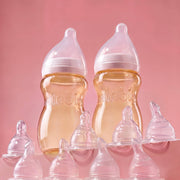
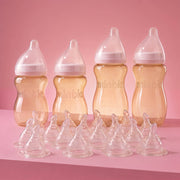
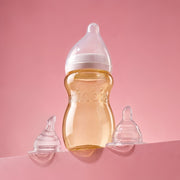


Conventional teat
- A different mouth shape from the breast, which can confuse a breastfed baby
- Milk drips with little effort, so babies learn to compress instead of suckle
- Flow can be fast and uneven, making feeds feel rushed
Your cart is empty
Start with our bestsellers, loved by breastfeeding families.
$65.00
$95.00
$31.49
$20.00
Our story
Minbie began with one question from our co-founder Julia: why should giving your baby a bottle mean giving up on breastfeeding?
Julia is a designer, sculptor, mother of three and grandmother. She spent years shaping handmade prototypes until she had a bottle teat that works with a baby’s instinctive breastfeeding motion, not against it. That teat is now patented, award-winning and used by more than 400,000 parents.

How it began
Decades ago, Julia was a new mum doing everything she could to keep breastfeeding her first son, Duncan. Two months in, one evening, Duncan was hungry and nothing would settle him.
A bottle from the chemist settled him in minutes. Julia was hugely relieved, and grateful. But something else stayed with her. “It was like he had found a switch,” she remembers. “He looked like he was feeding differently.”
Over the following weeks, the bottle took more and more of the feeds. It’s a story many mums will recognise. Julia never forgot it, and she became determined to bridge the gap between breast and bottle.
Once her own three children were grown, she finally had the time to answer the questions she had carried for years. What is the real difference between a breastfeed and a bottle feed? And what would a teat need to do to keep the two close?
How Minbie came to be

Conventional teats let milk flow with little effort. Babies can learn an easier technique and start to prefer the bottle, which makes going back to the breast harder.

Watching waves roll onto a long beach, Julia saw it: at the breast, babies feed with a smooth, wave-like tongue motion that lets them control every sip.

As a sculptor, Julia shaped prototype after prototype by hand, until the teat asked babies to latch and feed with that same active, wave-like motion.

Patented, recognised with Red Dot and Good Design awards, and joined by an orthodontic dummy designed with the same care.
“A unique cycle is created when babies are able to latch well and draw milk the way they do at the breast. Our bottle teat was designed around that instinctive technique.
I strongly believe families shouldn’t have to choose between sharing feeds and breastfeeding. They deserve a bottle that works with that special bond.”
Not all teats are equal
Most bottle teats let milk flow with little effort. Minbie’s patented teat keeps your baby using the same active latch and suckling motion they use at the breast.


The Minbie dummy
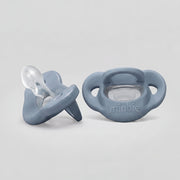
Julia brought the same thinking to soothing: a dummy that’s soft, slim and friendly to breastfeeding.
 Flatter and wider, not cherry-shapedA wide, flat teat and slim neck sit neatly and comfortably in your baby’s mouth.
 A shallower shieldIt sits lower on the upper lip and away from the nose, with vents to let skin breathe.
 One piece of soft siliconeNo joins or crevices for germs to hide, and an easy-grip handle you can pick up with one finger.
“It’s eclipsed all others and now I have about 20 other dummies sitting in the cupboard. It is magic, he loves it, so we love it.”
Not all dummies are equal
Traditional cherry dummies have a round, bulbous shape that fills your baby’s mouth. Minbie’s patented orthodontic design is slimmer, softer and made to work alongside breastfeeding.


What we believe
Breastfeeding isn’t always possible, and every family relies on a bottle at some point. Our hope is that when you do, it guides your baby back to the breast rather than away from it.
 Breastfeeding-first designIf you want to breastfeed, a bottle shouldn’t get in the way. Our teat is designed to work like breastfeeding.
 Room for real lifeA partner’s turn, a first day back at work, or a night of sleep. Sharing feeds should be easy.No guilt, no pressureBreastfeed, bottle-feed, combine or switch. Every family deserves practical help.
In parents’ words
“My baby took to it straight away and went back to the breast after, so Dad and others can now help with the many feeds a newborn needs.”
“We went through 4 other brands trying to find a bottle our breastfed baby would take. He refused them all until this one! Dad feeds him with the paced teat with no issues at all.”
“We tried 4 different brands of dummies, big brands and aesthetic ones, and the koala is the only one she’ll take. I have no difficulty breastfeeding her. We don’t go anywhere without it!”
Giving back
We partner with organisations that support families who need it most, from Baby2Baby in the US to community groups closer to home, donating bottles so more parents can feed with confidence.
 Patented, award-winning design
 Female-foundedDesigned by Julia, a mum of three
Your next feeding chapter